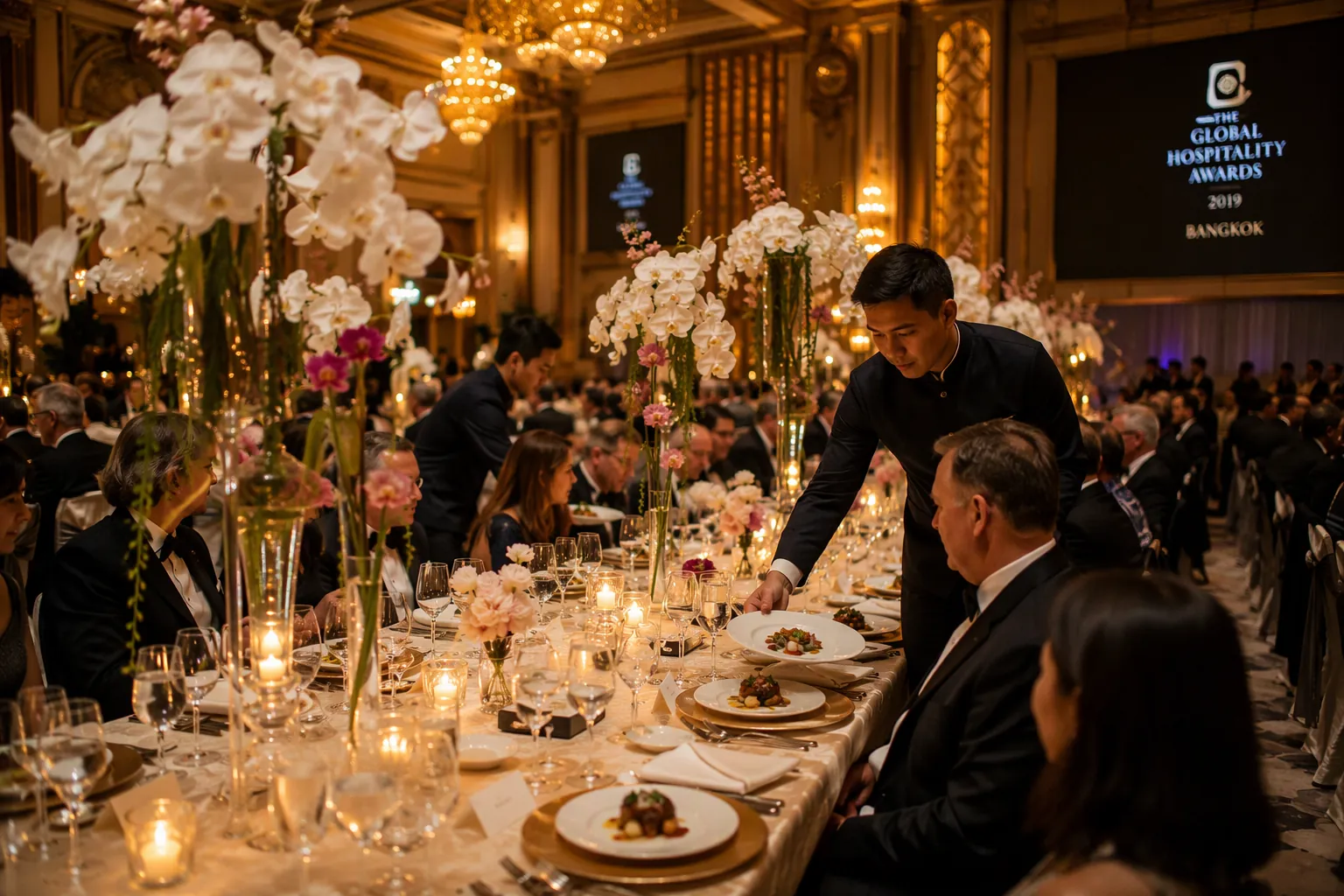
- Best default: four course plated Western menu: timing control for speeches and awards.
- Best for mixed Asian & Western tables: shared Thai banquet: generous, fast, dietary friendly.
- Budget: ~THB 1,800–3,500++ per head at five star Thai hotels; THB 420–820k all in for 200 with wine.
- Staffing: one server per 20–25 guests; one floor captain per station.
- The classic mistake: a menu chosen for ten people, served to two hundred.
A gala menu is an engineering problem wearing a tuxedo. At 200 guests, the kitchen has roughly four minutes to plate each course, the floor has fifteen to clear it, and your CEO's speech will definitely overrun. Choose the menu that survives all of that.
Course 01Pick the format before the food
Everything, timing, staffing, budget, even the seating plan, follows from the service format. Four formats work at 200 covers:
| Format | Best for | Timing control | Watch out for |
|---|---|---|---|
| Plated Western (4 courses) | Awards nights, formal galas | Excellent: courses land on cue | Needs disciplined service; keep it to 4 courses max |
| Shared Thai banquet | Mixed nationalities, incentive groups | Good: dishes land in waves | Table space; serve rice last or it goes cold |
| Live stations | Casual celebrations, networking | Loose: guests eat when they like | Queues at 200; you need 4+ stations, double sided |
| Classic buffet | Budget conscious large groups | Weakest | The 20-minute queue; release tables in order |
Our default for a corporate gala: plated if the night has a programme (speeches, awards, a show), because the kitchen can hold and fire courses around the stage. Shared Thai if the night is about the table itself: incentive dinners and welcome evenings, where passing dishes gets strangers talking.
Course 02Two menus that work
Both are built for Thai hotel ballrooms: ingredients the kitchens stock, dishes that hold for the four minute plate up, nothing that dies under a heat lamp.
Course 03The arithmetic of feeding 200
Timing
Bank on 15–18 minutes per plated course between first plate and last clear. A four course dinner with a welcome drink and coffee runs about two and a quarter hours of table time: build speeches into the gaps between courses, never during service. The single most common gala failure is a 20-minute speech delivered over a dying fish course.
Staffing
Plated: one server per 20–25 guests (8–10 for 200), plus a captain per station and a sommelier or wine waiter if you're pouring seriously. Shared Thai runs slightly leaner. If the hotel proposes one server per 40, push back or accept slower courses.
Drinks
For a three hour dinner: welcome sparkling (35–40 bottles for 200), then half a bottle of wine per wine drinking guest: at typical Thai corporate ratios (60–70% of guests drinking wine), that's 60–70 bottles, split about 60/40 red to white. Free flow packages at five star hotels run roughly THB 900–1,800++ per person for three hours of wine and beer; BYO with corkage (often THB 800–1,500++ per bottle) only wins if you're pouring something special.
Course 04Courses hotels get wrong at scale
- Soufflé, risotto, anything à la minute. If it can't survive four minutes on the pass, it can't be served to 200. Braised and roasted beat grilled and fried.
- The five course temptation. Every course past four adds 15 minutes and fatigue. Spend the money on better wine instead.
- Ice cream centre pieces. Melting desserts during the CEO's speech. Serve dessert after the programme, cold and fast.
- Fish that smells. Whole steamed fish is magnificent at a Thai banquet; grilled salmon that's sat under a lamp is not. Choose preparations designed for holding.
- A bread basket nobody asked for. At a Thai banquet it goes untouched; at a Western dinner it's the most eaten course. Match it to the menu, not the habit.
Course 05The budget picture
These are editorial planning figures, not quotes, but they hold up across five star ballrooms in Bangkok and Phuket in 2026: set menus THB 1,800–3,500++ per person, free flow drinks THB 900–1,800++, and room, staging and AV often quoted separately. All in, a 200-guest gala with wine typically lands between THB 420,000 and 820,000 after the 17.7% service and tax uplift. Four star ballrooms and off peak dates (Sunday–Wednesday, green season) pull the floor down to around THB 1,200++ per head.
Nobody remembers the third course. Everybody remembers if the night moved.