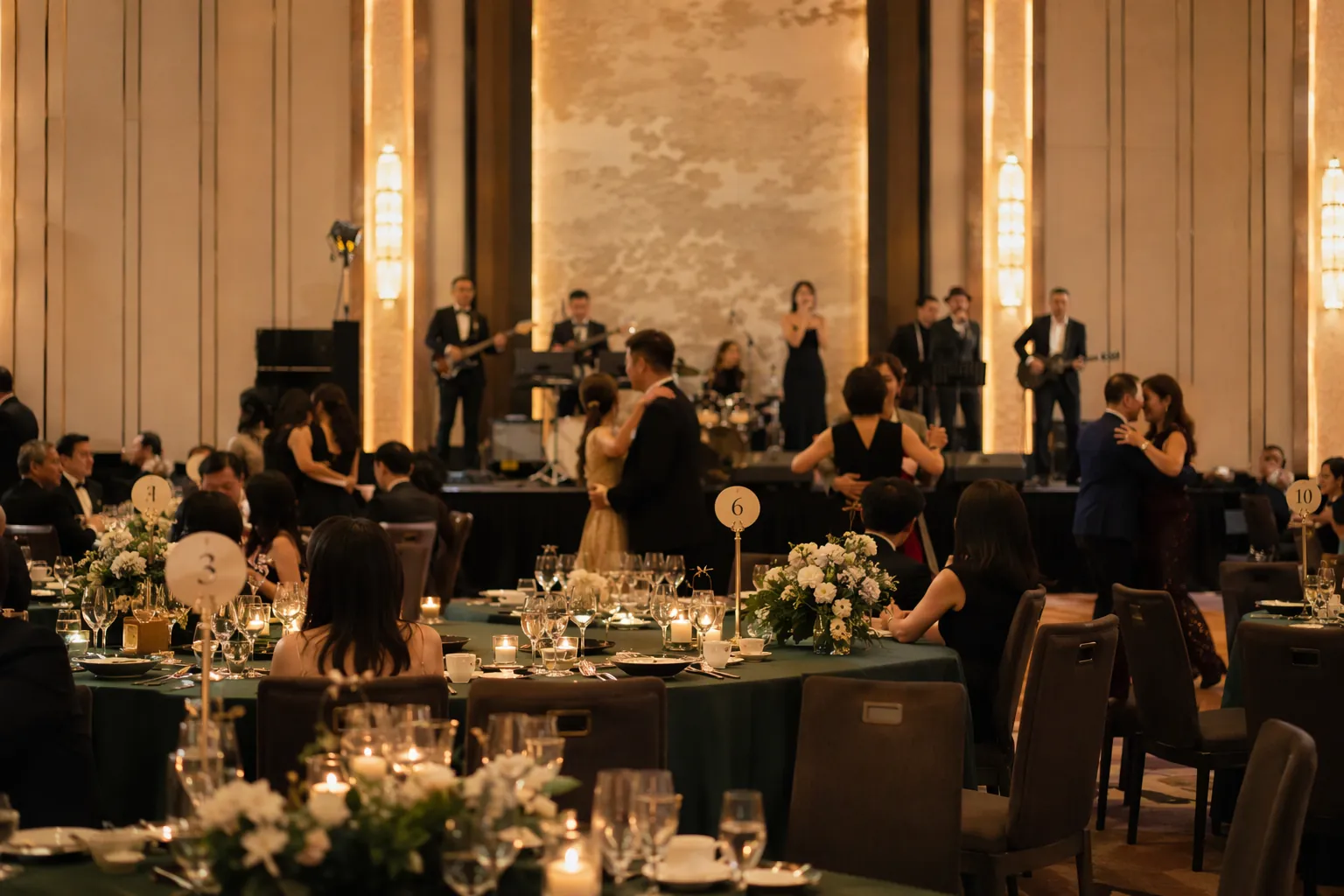
- Budget: S$128–238++ per person at hotel ballrooms; often quoted per table of 10.
- Format: eight course Chinese set for mingling crowds; Western plated for formal award nights.
- Drinks: free flow beer & wine adds ~S$30–60++ per person.
- Season: November–January peak; book 3–6 months out for Friday/Saturday.
- The rule: the menu must survive the dance floor. Nothing that dies in 20 minutes.
The dinner and dance is Singapore's great corporate institution: one night a year when the whole company dresses to a theme, eats eight courses, loses money at the lucky draw and dances to a cover band. Get the menu and the rhythm right and HR looks brilliant for twelve months.
Course 01How D&D pricing works
Singapore hotels quote D&D packages per table of 10: typically S$1,288–2,388++ per table, which is S$128–238++ per person, scaling with hotel tier and menu ambition. The "++" adds 10% service and 9% GST (about 19.9% on the bill). Packages generally include the set menu, house PA and staging, a dance floor and standard table settings; the band or DJ, emcee, themed décor, extra AV and drinks packages price separately. Minimum table counts apply: ballrooms often start at 15–20 tables.
Course 02Chinese set or Western plated?
| 8-course Chinese set | Western plated (4–5 courses) | |
|---|---|---|
| Pacing | Dishes land in the middle: guests eat around stage games without missing food | Courses arrive per person: pauses needed for programme segments |
| Dietary flexibility | Vegetarian/halal tables plated separately with notice | Easier per guest substitutions |
| Feel | Communal, generous, traditional: the classic D&D | Formal, paced, suits awards heavy nights |
| Risk | Course fatigue: eight courses is a marathon | A 20-minute lucky draw can kill a plated course |
Default advice: Chinese set for a party crowd, Western plated for an awards night. The classic eight course set, combination platter, soup, fish, prawn, meat, vegetable with rice or noodles, then dessert, survives interruptions gracefully because the food sits in the middle of the table. A plated fillet does not forgive a surprise dance segment.
Course 03Menus that survive the dance floor
- Hold friendly proteins. Braised, steamed and roasted dishes wait patiently through the CEO's speech; grilled fish and soufflés don't.
- Dessert that can sit. Chilled mango pomelo or a plated chocolate tart holds through the lucky draw; ice cream doesn't.
- Skip the intermission course. Every course past the format's norm adds 15 minutes to a night that already runs late.
- Late night bait. The best D&D trick: a small supper station (noodles, satay) appearing at 22:30 when the dancing burns through dinner.
Course 04Drinks packages, decoded
Most hotels offer tiered free flow extras, roughly S$30–60++ per person for three to four hours of house wine and beer, with soft drinks often bundled into the base package. Spirits often price by the bottle with corkage style markups. The sum to do: count your real drinkers, not your headcount, at tables of teetotallers, bottles by consumption beat free flow. For a 200-person D&D with typical Singapore drinking patterns, free flow for all often wins on simplicity; for smaller, mixed company dinners, quote both.
Course 05The night, timed
Course 06The booking calendar
Peak D&D season is November through January: year end celebrations, with a second wave of Chinese New Year company dinners in January–February. For peak Fridays and Saturdays, book three to six months ahead; the grand ballrooms of the big five stars and the view venues (Marina Bay facing, Sentosa) go soonest. Off peak months close in six to eight weeks, and weekday dates (Tuesday–Thursday) get clearly better per table rates at the same hotels. Confirm menu tasting two to four weeks out. Most hotels include one for the organising committee.
A D&D succeeds on rhythm: food that waits, games that don't drag, and a dance floor that opens before the energy dips.